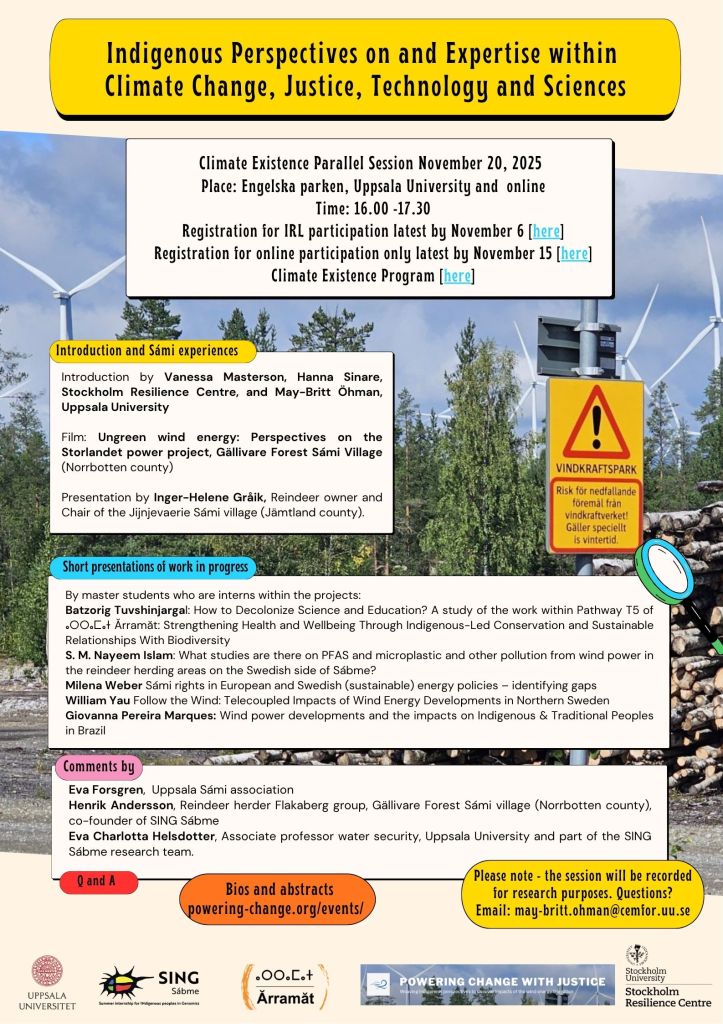
Welcome to an online and in-person parallel session at the Climate Existence Symposium 2025 in Uppsala.
Place: Engelska parken, Uppsala University and online
Time: 16.00 -17.30
Registration for IRL participation latest by November 6 [here]
Registration for online participation only latest by November 15 [here]
For any issues with registration – please email: poweringchangewithjustice@gmail.com
Scroll down for abstracts and bios.
Please note that the session will be recorded for our research projects. Your name and face will not be shown. You can ask questions anonymously if you like. Our research has been evaluated by the Swedish Ethics Review Authority, Etikprövningsmyndigheten, Dnr 2024-07932-01.
For any questions regarding the research projects, please contact Dr Vanessa Masterson, email: vanessa.masterson@su.se or Dr May-Britt Öhman, email: may-britt.ohman@cemfor.uu.se
Session Summary
Presentations on research in progress within Powering Change With Justice: Weaving Indigenous perspectives to uncover impacts of the wind energy transition, funded by FORMAS, led by Dr Vanessa Masterson, Stockholm Resilience Centre; ⴰⵔⵔⴰⵎⴰⵜ Ărramăt: Strengthening Health And Wellbeing Through Indigenous-Led Conservation and Sustainable Relationships With Biodiversity, based at University of Alberta, Edmonton, and SING Sábme: Questioning “Green Energy” and its Impact on Indigenous Livelihoods in Sweden, all co-led by Dr May-Britt Öhman, Centre for Multidisciplinary Studies on Racism, CEMFOR, Uppsala University
Moderator: May-Britt Öhman
Abstracts
Film Ungreen wind energy: Perspectives on the Storlandet power proj, Gällivare Forest Sámi territory 7:33 min. Öhman, M-B; Andersson, H.; Storlöpare, Petri. ( 2021)
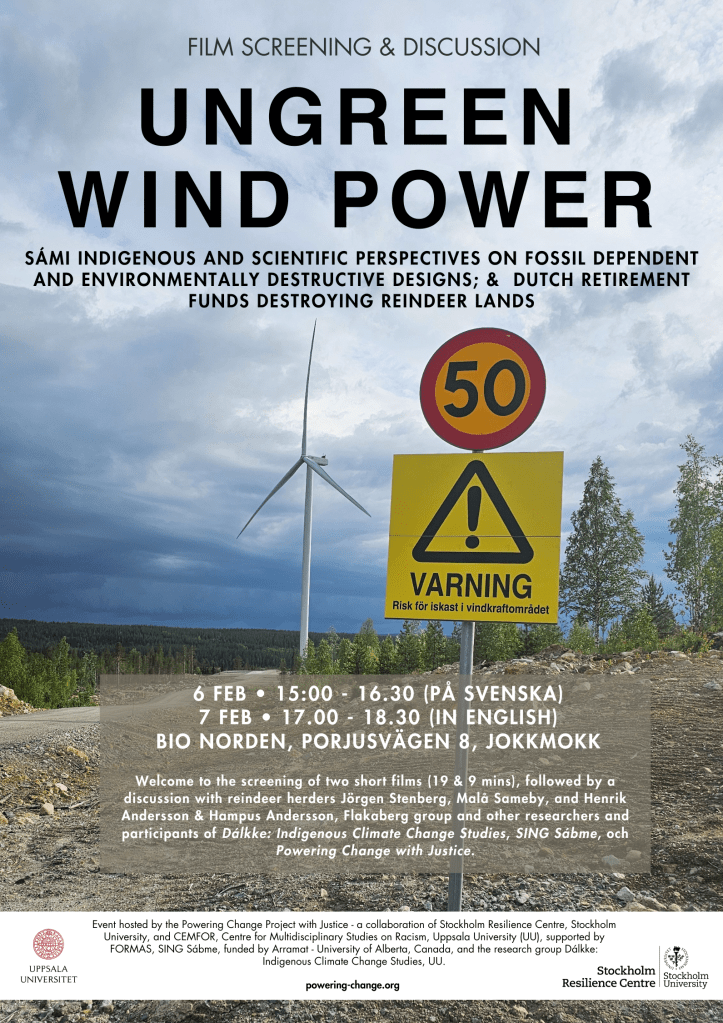
In this documentary filmed in September 2020, Henrik Andersson, reindeer herder within Gällivare Forest Sámi village speaks about the environmental destruction caused by the Swedish state, through forestry practices by the state owned forest company Sveaskog, as well as the planned wind energy industrial area by the state power company Vattenfall. He also shows what a healthy forest should look like.
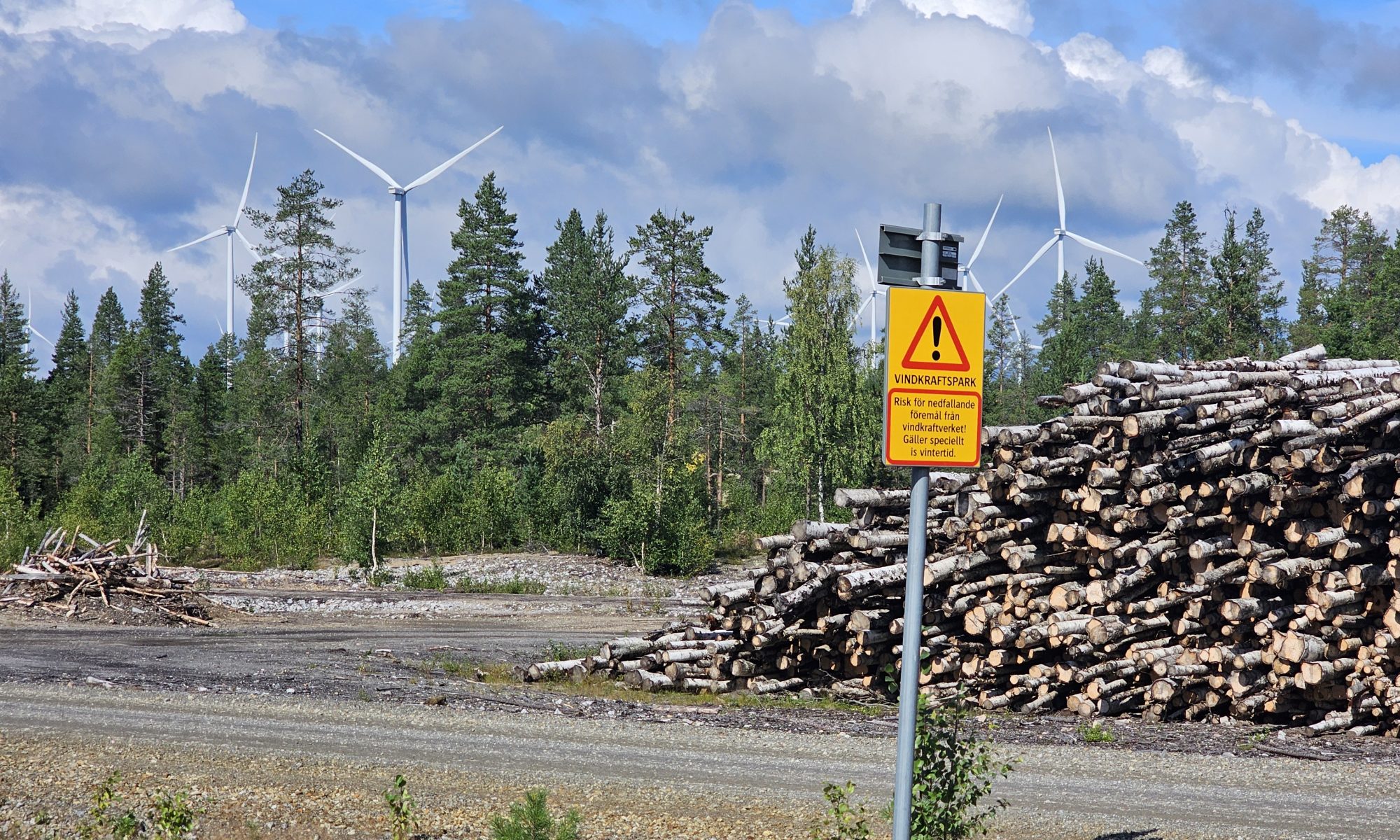
The area discussed is one out of two large project areas for windpower within Gällivare Forest Sámi village – “Storlandet”, which is the ancestral grounds of his family. Work is ongoing. In September 2025, 2025, Vattenfall submitted an application for an environmental permit to the Land and Environment Court at the Umeå District Court.
The Swedish state, the European Union (EU), as well as actors within the energy market, environmental organizations and climate activists all insist in the promotion of windpower as “green”, fossil free and thereby environmentally friendly. A major part of these constructions are planned for in Sámi territories, on land that were stolen from Sámi during late 19th and early 20th century, the Sámi taxlands.
Furthermore, the wind power industrial areas have major negative impacts for the local environment. Forests are clear cut and replaced with 100 – 300 meters high steel constructions, on massive foundations made of concrete. Construction and maintenance demands new mines, car and truck access roads and thereby new stone quarries causing major wounds in the landscape. These industrial areas have major negative consequences for the local environment, fresh water, nature, wild life, local inhabitants as well as reindeer herding. Pollution from the wind power constructions is still rarely addressed such as oil spills, release of microplastics and PFAS.
This documentary is part of a supradisciplinary research and documentary project on (un)sustainable power production, researching and documenting the subject matter from Sámi reindeer herding point of view, along with analyses of the whole windpower complex.
The research was funded by the Swedish Research Council Formas, 2017-01923 and 2019-01975, both projects were part of the Swedish National Research Programme on Climate, and led by Dr May-Britt Öhman, Uppsala University.
Inger-Helene Gråik
Experiences from two decades of struggles with wind power in Jijnjevaerie Sámi village, Jämtland County.
Read more: The Experience of a SÁMI Reindeer Community Affected by a Large Wind Power Project. / Marianne Gråik and Karin Buhmann.
The Routledge Handbook on Meaningful Stakeholder Engagement. Routledge, 2024. p.193-198 Find at DOI 10.4324/9781003388227-16
Short presentations by master students within the projects, 5 minutes each:
Batzorig Tuvshinjargal
The Arramat Project Pathway T5 and the Indigenous-Led Place-Based Projects (ILPBPs)
The ⴰⵔⵔⴰⵎⴰⵜ Ărramăt: Strengthening Health And Wellbeing Through Indigenous-Led Conservation and Sustainable Relationships With Biodiversity Project is funded by the Government of Canada with ca 184 MSEK during 2022-2028.
Arramat supports more than 80 Indigenous-led Place-Based Projects (ILPBPs) in 38 countries and over 75 Indigenous territories, all aimed at exploring the vital interrelationships between Indigenous health, well-being, and biodiversity conservation. Within Arramat there are also 10 Global Transformation Pathways led by Indigenous scholars and Indigenous Knowledge holders, with the task to liaise the ILPBPs. Co-led by three prominent Indigenous scholars, Pathway T5 is dedicated to Indigenizing/Decolonizing Science and Education.
During fall of 2025 I assist the T5 with setting up webinars/vodcasts, and a literature review of Indigenous scholarship work with the theme of Decolonizing science and education. I also work with an overview of the ILPBPs, investigating how they work with Decolonizing Science and Education. In this presentation I will present the findings so far, based on the successful ILPBP grant proposals, and on existing reports.
Giovanna Pereira Marques
Wind power developments and the impacts on Indigenous & Traditional Peoples in Brazil
This presentation reports on work-in-progress on the concerns and objections from indigenous and traditional people from north-east Brazil regarding industrial wind developments. Brazil’s green transition is described as critical to mitigating the climate crisis. But windpower developments are often framed in technical and depoliticised language – which acts as a form of discursive exclusion – through expressions such as “clean energy” and “green energy” as a way to delegitimize conflicts and harm that these developments bring to marginalized populations.
We report on a media and literature scan, synthesizing the key arguments and discourses of energy justice and green grabbing, and the unequal impacts of wind developments on human rights, health, and ways of life for Indigenous and traditional communities in Brazil. We highlight how wind energy developments exacerbate inequalities for traditional communities such as quilombolas who have fewer and more insecure rights to territory.
William Yau
Follow the Wind – Telecoupled Impacts of Wind Energy Developments in Northern Sweden
For a decade, wind energy has been promoted as an important driver of Sweden’s transition to renewable energy. However, such development in green energy transition has created severe negative ecological effects and deepened inequalities, in rural local communities and in Sámi reindeer herding territories.
I will present the work I do with my master’s thesis, within which I will use a framework called telecoupling. Telecoupling focuses on how faraway places are connected and affect each other. I will look at wind energy development in Norrbotten, Västerbotten, Jämtland and Västernorrland, using telecoupling to examine how local development decisions are affected by investment, technology, and policies from other regions (including other parts of Sweden and other European countries).
I aim to lay out a more complete picture of who benefits from the wind energy development in northern Sweden, by gathering and analyzing data from online databases and wind project websites. I will also look at the costs of such developments, and how they may disproportionally affect local communities. I plan to analyze literature to study the costs to local communities, and to interview local actors to capture nuanced local impacts. The final goal of the study is to have a critical review of who benefits and who pays for the burden of transitioning towards a renewable energy model.
Milena Weber
Sámi rights in European and Swedish (sustainable) energy policies – identifying gaps
Current wind energy developments risk undermining Sámi self-determination and land-use rights affirmed in Swedish legislation (SFS 1971:437; SFS 1974:152, 1-2 kap.) and international frameworks, such UNDRIP (United Nations Declaration on the Rights of Indigenous Peoples) and the ICCPR (International Covenant on Civil and Political Rights).
Reindeer husbandry, which supports Sámi identity and sustainable use of old growth forest, faces profound threats from habitat fragmentation, cumulative disturbances and altered migration patterns associated with wind infrastructure.
This presentation offers early insights from the project Powering Change with Justice. It examines how Swedish and EU-level policies governing wind expansion conceptualise Sámi rights and knowledge, asking: Do current policy frameworks meaningfully safeguard Indigenous land use and participation, or do they reproduce structural inequities?
Preliminary findings suggest that policy discourses largely assume peaceful coexistence between wind development and Sámi land use, rather than assessing cumulative harm. The legal and planning landscapes remain fragmented, technocratic and often inattentive to Indigenous perspectives and lived experiences.
Emerging patterns point toward a persistent green extractivist logic in energy governance, where climate action risks reproducing colonial dynamics unless Indigenous rights and participation are centralised. By foregrounding Sámi perspectives and exposing persistent policy blind spots, this work seeks to contribute to a more just and accountable energy transition in Sweden and the EU.
S. M. Nayeem Islam
What studies are there on PFAS and microplastic pollution and other pollution from wind power in the reindeer herding areas on the Swedish side of Sábme?
I will present my work with identifying studies of pollution from wind power industries within the Sámi reindeer herding areas in Sweden. The primary focus is on microplastics and PFAS. However, I will also take into account other types of pollution that show up in ongoing studies and in Environmental Impact Assessments (EIAs) preceding the construction of windpower plants.
The empirical material is based on first of all email correspondences with all the County Administrative boards – Länsstyrelser – in the reindeer herding area (Norrbotten, Västerbotten, Västernorrland, Gävleborg and Dalarna), asking what kind of pollution they are studying, and if they do study PFAS and microplastic pollution from wind power plants.
Secondly, I look into the EIAs that are part of the permission process for these wind power plants. The EIAs are made by the wind power companies themselves.
The objective of the study is to map the current knowledge and ongoing studies within the regional authorities – Länsstyrelserna – regarding pollution from wind power installations, while highlighting the environmental dangers with PFAS and microplastic. The ambition is also to visualize the pollution with Geographic Information System (GIS) tools, to enhance the understanding of the pollution from wind power in the nature and waters surrounding wind power plants. Furthermore the ambition is to advocate for more transparent, independent and science based environmental monitoring of wind power projects.
Bios

May-Britt Öhman is associate professor in environmental history, researcher at the Centre for Multidisciplinary Studies on Racism, CEMFOR, Uppsala University. Öhman is Lule and Forest Sámi of the Lule River valley, Swedish side of Sábme, and has also Tornedalian heritage. Öhman leads the supradisciplinary research group Dálkke: Indigenous Climate Change Studies, and several research projects working towards the establishment and development of the research field Indigenous Climate Change Studies, centering Indigenous peoples’ expertise, experiences, perspectives and epistemologies, through publications, film making, organization of seminars, workshops, and networking. Exchange and collaboration with Sámi reindeer herders and Sámi associations spans over two decades. A major point of interest is to make space for Indigenous-Sámi expertise in academia – as scholars, experts, research leaders. Öhman is co-founder of SING Sábme, Co-lead within ⴰⵔⵔⴰⵎⴰⵜ Ărramăt, Pathway T5 – Decolonizing Science and Education, and co-lead of a Work Package of Powering Change with Justice.

Vanessa A. Masterson is a researcher at Stockholm Resilience Centre, Stockholm University, and associate researcher at the Department of Anthropology at Rhodes University, South Africa. She holds a PhD in Sustainability Science and her research explores cultural, personal and relational values of nature which play a critical role in our well-being and stewardship of ecosystems. She has a particular focus on participatory, emancipatory and arts-based methods to facilitate mobilization of local and Indigenous knowledge systems and perspectives in transdisciplinary arenas. Masterson leads the project ‘Powering Change with Justice’ which weaves together Indigenous knowledge and cross-scale policy analyses to examine the social and ecological impacts of the wind energy transition and alternative futures for Sámi communities in northern Sweden, and local and traditional communities in Brazil.
Hanna Sinare is a researcher at Stockholm Resilience Centre, Stockholm University. Within the Powering change with justice project, Sinare leads the analysis of inclusion of rights of Indigenous Peoples and Local Communities (IPLCs) in (sustainable) energy policies. She also works with research on how UNESCO designated Biosphere Reserves/Areas work as learning sites for approaches to combine conservation of biodiversity and biocultural diversity with sustainable social and economic development, including inclusion of IPLCs in decision making and management. Other current and past work include transdisciplinary co-production processes towards locally identified aspired futures, including a wide range of actors, and analysis of the impact of framings in European development and trade policies for pathways towards aspired futures in Senegal and Brazil. Sinare has conducted research related to sustainable development in agri-food systems in dryland West Africa (Burkina Faso, Senegal, Mali) for 15 years, including on landscape multifunctionality, landscape and climate change, and youth experiences in rural areas.
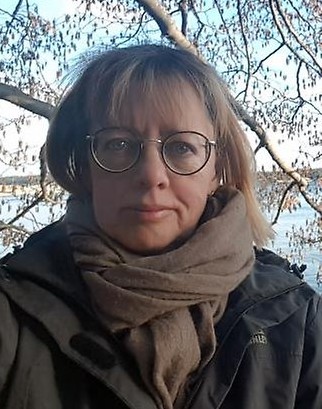
Eva Charlotta Helsdotter is Associate Professor in Water Security with a PhD in Land and Water Resource Technology. She has been a research leader in land and water issues internationally—including in Bolivia, Nicaragua, Kenya, Tanzania, and also been responsible for environmental and recycling projects in Sweden. Since 2010 she has been involved in research projects in Sábme. Helsdotter is an expert within the SING Sábme team.
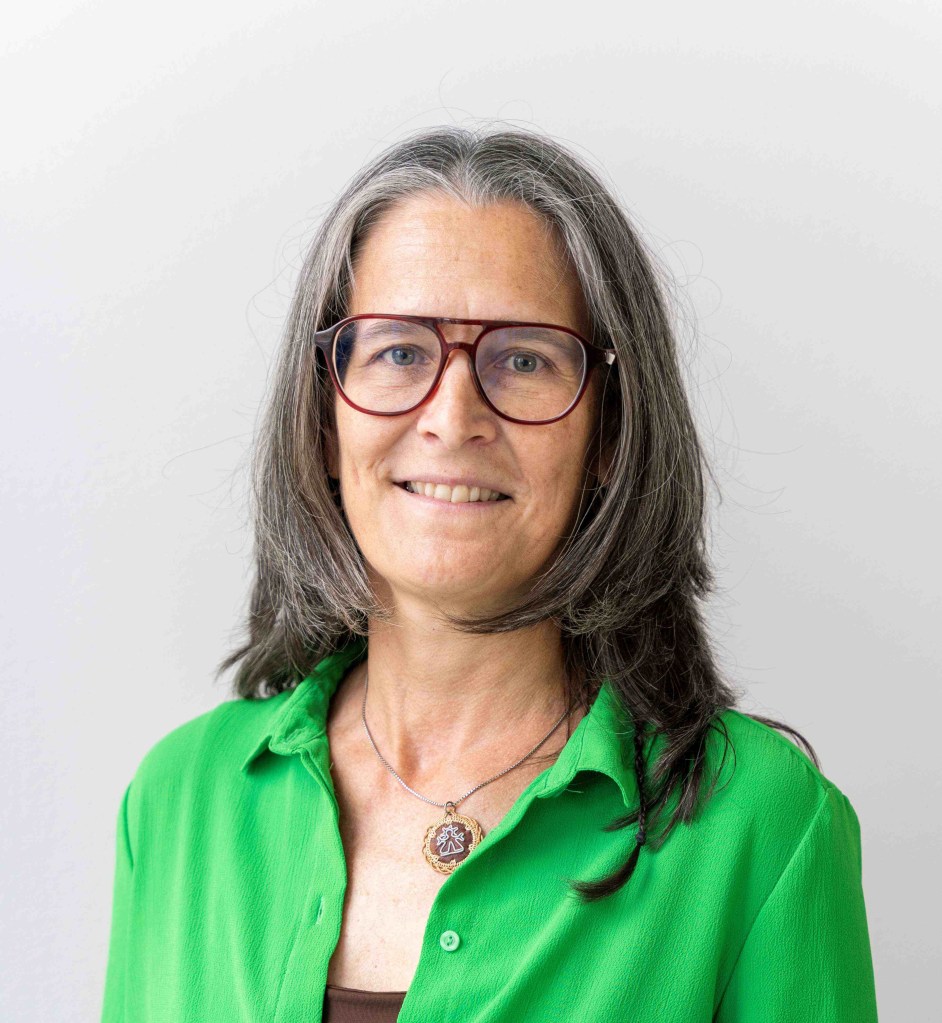
Lisa Deutsch is a Senior Lecturer at the Stockholm Resilience Centre and has a PhD in Natural Resources Management. Lisa’s research examines the political economy of agro-food globalization and the often “hidden” social-ecological consequences of current modes of production and commercialization. She particularly focuses on the ways in which global trade can change the mix of inputs to food and feed. Her most recent book focuses on the “Miracle Bean” – the soybean – and its shifting roles over the long historical development of our present global agrofood system. Within the Powering change with justice project, Lisa is a member of the Advisory Board and works on the quantification and analysis of benefits and impacts associated with wind energy production in Sámi territories in northern Sweden (WP1: Distal Impacts).

Amanda Jiménez Aceituno is a sustainability researcher at the Stockholm Resilience Centre with a background in Environmental Sciences and a PhD in Environmental Education. Jiménez´s work focuses on sustainability transformations, contributing to its conceptual and methodological development, such as the use of the values-rules-knowledge framework or the leverage points approach to reveal the transformative potential of Indigenous Peoples and Local Communities (IPLC)- led initiatives (e.g., Jiménez-Aceituno et al. 2025). The Seeds of the Good Anthropocenes approach has been a key platform in her study of transformations. Jiménez also works on developing and implementing transdisciplinary research methods that can enhance our understanding of collective processes and foster sustainability in social-ecological systems. Within the Powering change with justice project, Jiménez co-leads the quantification and analysis of benefits and impacts of wind energy production in Sámi territories in northern Sweden (WP1: Distal Impacts).
Eva Forsgren is a Sami with her heritage in Jovnevaerie Sami village. She sits on the board of the Sami Association in Uppsala. She also works with information and advocacy on Sami rights, against racism, hatred and threats against the Sami, land exploitation, and the repatriation of human remains and sacred objects to Sápmi, Sami land. For several years, Eva has been working on handling issues related to the Archive and Photo Collection of the former State Institute for Racial Biology. Eva is also a recreational musician and runs her own company in information management and lecturing.

Henrik Andersson is a reindeer herder within the Flakaberg group of the Gällivare Forest Sámi village – a reindeer herding economic and geographic association, on the Swedish side of Sámi territories. Born into reindeer herding, he has worked full time within reindeer herding the last thirty years. He took the initiative to and stars in the documentary The Last Generation? (2016) in collaboration with filmmaker Petri Storlöpare, Slowlife Film. He also appears in the short documentary Ungreen windpower: Sámi Indigenous and scientific perspectives on fossil dependent and environmentally destructive designs, produced in collaboration with the Dálkke: Indigenous Climate Change Studies research group led by May-Britt Öhman. Furthermore he is a co-founder and expert within SING Sábme.

Inger-Helene Gråik, Reindeer owner and chair of the Jijnjevaerie Sámi village (Jämtland county). Inger-Helene is 39 years old, born and raised in a reindeer-herding family in the Hotagen mountains, northwestern Jämtland. She is the oldest of four siblings, has three children and is married to a reindeer-herding colleague from a neighboring Sámi community. Inger-Helene works in reindeer herding and is dedicated to preserving Sámi cultural existence.

Batzorig Tuvshinjargal is a master’s student at Uppsala University pursuing a degree in the field of sustainable development. He is an intern for the ⴰⵔⵔⴰⵎⴰⵜ Ărramăt and its pathway 5 Decolonizing Science and Education, as well as with Powering Change With Justice. In addition, he works as a course coordinator at the Centre for Environment and Development Studies (CEMUS).
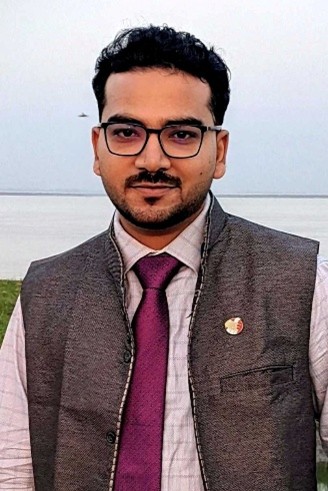
S M Nayeem Islam is an environmental professional with proven expertise in project-level compliance and strategic research. He is currently advancing his knowledge as a research intern with CEMFOR, intern for the Powering Change With Justice project as well as ⴰⵔⵔⴰⵎⴰⵜ Ărramăt and a Master’s candidate in Sustainable Development at Uppsala University. Previously, he served as an Environment Officer on World Bank projects, successfully implementing Environmental Management Plans (EMP), conducting impact analyses, and leading capacity-building training. He leverages this experience, along with skills in GIS and disaster risk reduction, to develop robust sustainability strategies that bridge the gap between policy and practice.

William Yau is a master’s student at the Stockholm Resilience Centre (SRC). He joined the SRC to strengthen his understanding of the resilience concept and system thinking. He seeks to apply these concepts to the broader society at different levels and analyze practical issues with a system perspective. He is working on his thesis with WP1 of the Powering Change with Justice project, building a comprehensive picture of the impacts of wind energy development in Northern Sweden using a telecoupling lens.

Milena Weber is a German-Irish student pursuing an M.Sc. in Sustainable Development at Uppsala University and SLU. They are currently interning with the Powering Change with Justice project at Stockholm Resilience Centre, assessing wind energy policies and interviewing policymakers to explore how Sámi rights and perspectives are integrated. Milena holds a B.Sc. in Global Environmental and Sustainability Studies and Political Science from Leuphana University in Germany, specialising in environmental justice, international development cooperation and deliberative democracy. They also coordinate the policy working group of Klimamitbestimmung e.V., which advocates for citizens’ assemblies to strengthen democratic participation and climate policymaking in Germany.

Giovanna Pereira Marques is a Brazilian student living in Sweden while taking her bachelor degree in Latin American Studies programme within the Nordic Institute of Latin American Studies, NILAS, at Stockholm University. Currently working as an intern at SRC for the Powering Change with Justice project. One of her interests is regarding the social consequences of the energy transitions and environmental racism.
 Powering Change With Justice